

When the Buyer Doesn’t Want to Get a New Survey

Paragraph 6C of the TREC Contracts: Survey Options
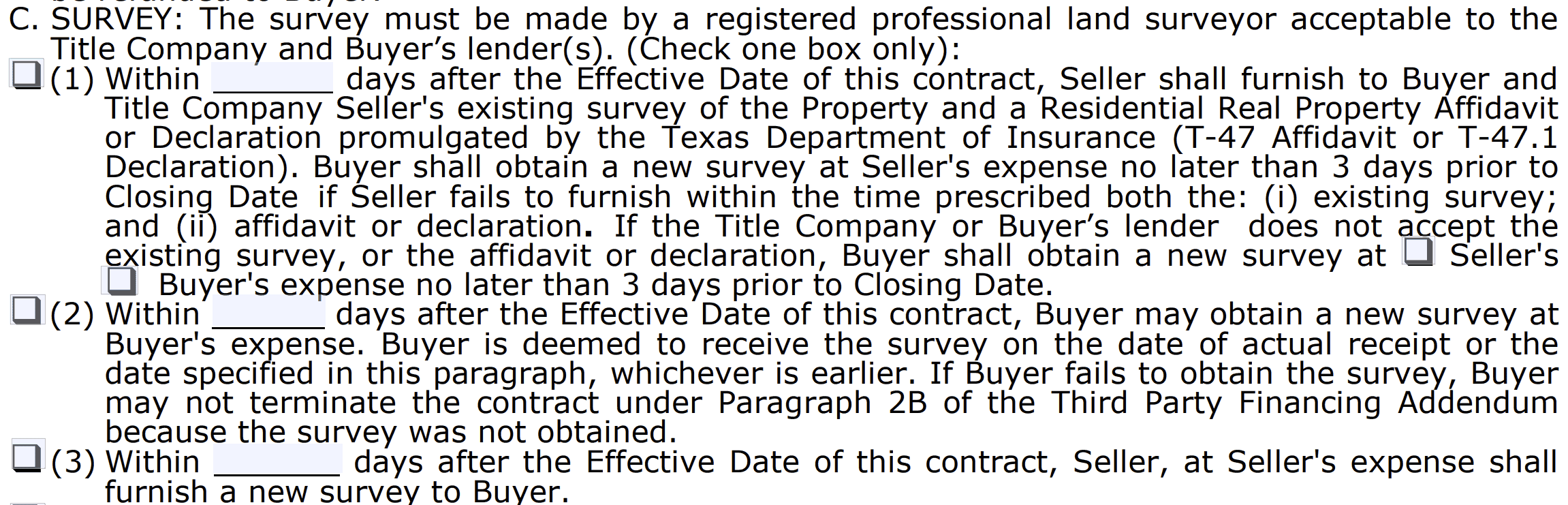
Our TREC contract forms contain 3 options regarding the survey:
-
6C(1): Seller will furnish a copy of their existing survey and either an Affidavit or Declaration regarding any known changes since the survey was done
-
6C(2): Buyer obtains a new survey for the transaction at the Buyer’s expense
-
6C(3): Seller obtains a new survey for the transaction at the Seller’s expense and furnishes it to the Buyer
This post will focus on Scenario 2 – when an existing survey is not available and the Buyer will obtain a new one if necessary.
When a Survey Might Not Be Required
For most transactions involving traditional financing (e.g conventional, FHA, VA, or USDA loans), the lender requires an acceptable survey of the property as a condition for making the loan. Recall that the property is the lender’s collateral for the loan, so they have a vested interest in discovering potential problems which might be revealed on a current survey, such as encroachments, boundary line issues, and easements. When there is no loan involved in the purchase (true cash purchase by the Buyer), there is no lender to require a survey of the property if the Buyer chooses not to have one. When the Buyer is using non-traditional financing (e.g. “hard money” loan, portfolio lending, seller financing, loan from a family member), the lender may not require a current survey of the property before making the loan.
Keep in mind that either a new survey or an old survey acceptable for re-use would be required if the Title Insurance Policy is going to have Survey Coverage added, even if neither the buyer nor lender requires a new survey. This blog post examines Survey Coverage in detail.
Completing the TREC Contract When the Buyer Does Not Want a Survey
If there is no current survey for the Seller to provide and the Buyer is willing – and able – to waive having a survey for the transaction, Paragraph 6C(2) of the TREC contract would be checked:
“Within ___ days after the Effective Date of this contract, Buyer may obtain a new survey at Buyer’s expense…”

In the contract form revisions passed by TREC in November 2024, this paragraph was changed from “shall obtain” to “may obtain,” which allows the Buyer to make the choice during the transaction if they are able to move forward without a new survey. Thus, a Buyer would just choose not to order a new survey and there is no need to make any other modifications to the contract. Prior to this change in the paragraph’s language, Buyers and agents were leaving Paragraph 6C blank (ambiguous and potentially negligent) and/or writing a Special Provision to specify that the Buyer neither requires nor desires a survey of the property (potentially the unauthorized practice of law).
It is important for all license holders to understand this one-word change and the intent/application of it. Continuing to leave Paragraph 6C blank or writing a Special Provision to waive the survey potentially subjects the license holder to a TREC violation for negligence/incompetence or the unauthorized practice of law.
Trying to Reuse a Survey But Waiving It If Unacceptable for Reuse
Our TREC form is not built to handle this combination of scenario 1 and 2. The best course of action is for the Buyer to select 6C(2) for “Buyer may obtain”, then the Seller can provide their existing Survey and Affidavit (or Declaration) for review. There is nothing that prevents the title company from approving the existing survey under this scenario, but it is not made a contractual requirement for the Seller to provide the existing survey and determine who will purchase the new survey. If you read Scenario 1 carefully (Para. 6C(1)), a new survey *must* be purchased by one of the parties if the existing survey and Affidavit/Declaration aren’t acceptable to the title company or Buyer’s lender.
-------
Bart Stockton is Associate Broker (TX & OK) and Chief of Operations for Paragon. An educator at heart, Bart writes and instructs continuing education courses focusing primarily on the topics of contracts, law, ethics, and risk reduction. He has been using em dashes since well before the robots were taught how to write. Nothing in this post shall constitute legal advice; consult a skilled real estate attorney. ©2026 Bart Stockton Real Estate Education. All rights reserved. Used by permission.