

Seller’s Disclosure Regarding Property Condition
In the olden days, property transactions were governed by “buyer beware” and the seller had no duty to disclose known conditions. In the 1990s, however, both Texas and Oklahoma legislatures realized that sellers should have a legal duty to disclose known defects. While buyers do still bear the burden of discovery related to the property condition (inspecting and discovering unknown defects), known defects must be disclosed by sellers and, if sellers refuse, by real estate agents involved in the transaction.
In this post:
Texas Seller’s Disclosure Notice
Statutory Exemptions to the Notice (TX)
Exempt from the Notice vs. Exempt from Disclosure (TX)
Consequences for Failure to Provide the Notice (TX)
Common Misconceptions and Questions (TX)
Oklahoma Residential Property Condition Disclosure Act
Oklahoma Exemptions to Disclosure or Disclaimer
Oklahoma Psychologically-Impacted Real Estate

Texas Seller’s Disclosure Notice of Property Condition
Chapter 5 of the Texas Property Code concerns conveyances of real property. Section §5.008, within the General Provisions of Subchapter A, requires certain sellers of residential property to provide the buyer with a Seller’s Disclosure Notice of Property Condition containing at least the minimum information in the statute.
Choice of Form
The Texas Real Estate Commission produces a Seller’s Disclosure Notice form which closely aligns with the minimum requirements. Other entities, such as the Texas Association of REALTORS® or individual brokerages, have produced enhanced versions of the Notice to provide greater disclosure. A seller may voluntarily provide more information than is required - and more disclosure is always a good idea to protect both seller and buyer.
Exemptions to Providing the Texas Seller’s Disclosure Notice

There are several exemptions contained in the Property Code:
-
Transfer of non-residential property (§5.008(a)). The Notice is only required on residential property.
-
Transfer of property containing more than 1 dwelling unit (§5.008(a)). The Notice requirement applies only to single units being transacted. This means that the sale of an entire duplex, triplex, or quadplex would be exempt from the Notice because the “property” being transacted has more than one dwelling unit. This also means that a single-family-attached property (commonly called a half-duplex) or an individual condominium unit does require the Notice, unless a different exemption applies.
-
Transfer pursuant to a court order or foreclosure sale (§5.008(e)(1)). Most commonly, this is the actual auction on the courthouse steps when a lien or deed of trust is foreclosed.
-
Transfer by a trustee in bankruptcy (§5.008(e)(2)).
-
Transfer to a lender by the borrower under a mortgage or to the trustee under a deed of trust (§5.008(e)(3)). A classic example is when a borrower executes a deed in lieu of foreclosure to transfer the property to the lender or servicer to avoid foreclosure proceedings when the borrower cannot repay the loan.
-
Transfer by a lender or beneficiary under a deed of trust after they acquired title via foreclosure, the power of sale under a deed of trust, or a deed in lieu of foreclosure (§5.008(e)(4)). This is the sale to an end-user after a lender has received title to the property foreclosed or surrendered.
-
Transfer by a fiduciary administering a decedent’s estate, guardianship, conservatorship, or trust (§5.008(e)(5)). Note that there is a qualifies to this exemption: it must be a transfer by a fiduciary, rather than the owner. Fiduciary is the highest duty of care for another person that the law can impose; this means that you cannot be a fiduciary if you are acting on your own behalf – it must be on behalf of someone else. Common fiduciary roles include executor(-trix), administrator(-trix), receiver, guardian, and trustee.
-
Transfer from one co-owner to one or more other co-owners (§5.008(e)(6)). For example, if you and a friend purchase a property together and one of you later sells your interest to the other, a Seller’s Disclosure Notice is not required.
-
Transfer made to a spouse or to someone in the lineal bloodline of one of the transferors (§5.008(e)(7)). The statute says “lineal line of consanguinity” which would be direct blood ancestors/ascendants (parents, grandparents, etc.) or descendants (children, grandchildren, etc.). It would not include siblings or other relatives.
-
Transfer between spouses pursuant to a divorce or legal separation decree or a property settlement agreement incidental to a divorce or legal separation decree (§5.008(e)(8)). For example, if spouses divorce and one of them “gets” the house in the settlement, there should be a deed completed, and this transfer would not require a Seller’s Disclosure Notice.
-
Transfer to, or from, any governmental entity (§5.008(e)(9)). For example, sometimes cities, school districts, counties, or statutory districts buy and sell property. These transfers or sales would not require the Notice.
-
Transfer of a new residence which has never been previously occupied for residential purposes (§5.008(e)(10)). There are 2 parts to this exemption: (1) it must be a new residence (not a used residence or conversion from another property type), and (2) it must have never been previously occupied for residential purposes. There are been some interesting scenarios where a builder allowed an employee or “home tender” to live in a new build prior to the sale, which triggered the need for a Seller’s Disclosure Notice.
-
Transfer of property where there is no dwelling or the dwelling makes up 5% or less of the total value of the property (§5.008(e)(11)). This is commonly referred to as the “teardown” exception – meaning the house has such little value or utility that it needs to be torn down – but it is also applies to other transactions where nearly all of the value is in the land or non-residential improvements, such as large tracts of acreage or farm/ranch properties.
Exempt from the Notice vs. Exempt from Disclosure
Even when a seller has a statutory exemption, there is a difference between "Exempt from the statutory Seller's Disclosure Notice" and "Exempt from Disclosure of Known Material Defects." No one ever has an exemption from disclosing known defects that a buyer could later convince a court were material to them. That attempted legal action for failure to disclose could arise from various other statutes, such as the Texas Deceptive Trade Practices-Consumer Protection Act, or common law.
Knowing that buyers who are later unhappy with the property condition after closing can cause sellers to expend considerable time, effort, and money to defend themselves, regardless of final outcome, we will always advocate for any seller to disclose what they do know about the subject property that might be material enough for a buyer to latch onto later. Some fiduciary sellers truly have no knowledge of the property, having never set foot in it or such similar situation, whereas others may have some general familiarity with it, even if they have not visited or occupied it recently. It is conceivable for a seller to have some level of knowledge, including information which may have been relayed to them via an agent, property manager, family member, or neighbor.

Disclose, Disclose, Disclose!
Our advice to SDN-exempt sellers is to take a look at the statutory SDN form from TREC (which mirrors the Property Code minimum disclosure exactly) or the Texas REALTORS® form, which has additional disclosure items, and use it as a tool to guide the seller in considering whether they have actual knowledge of something that is disclosure worthy, then writing that down in a way that can be given to a prospective purchaser. That could be filling out an actual Seller’s Disclosure Notice form if there is a working knowledge of the property or it could be a short, typed or handwritten list of known items.
Consequences for Failure to Provide the Notice

Texas Property Code §5.008(f) requires the seller to deliver the Notice to the purchaser on or before the effective date of a binding contract. If a contract is entered without the (non-exempt) seller providing the notice, the buyer can terminate the contract for any reason – or no reason – within 7 days after receiving the notice. If the seller is not exempt, and the provision of a Notice has not been addressed in the contract, the Property Code is unclear on what happens if the seller never provides the notice to the buyer. It’s likely that a buyer could pursue default against the seller under the Property Code requirement. It’s certainly a good way for a seller to end up on the ugly end of a Deceptive Trade Practices-Consumer Protection Act (DTPA) lawsuit for failure to disclose if the buyer purchases without disclosure having been made.
Luckily, the TREC contracts have a provision to address this scenario when it applies: “[ ] Buyer has not received the Notice. Within ___ days after the Effective Date of this contract, Seller shall deliver the Notice to Buyer. If Buyer does not receive the Notice, Buyer may terminate this contract at any time prior to the closing and the earnest money will be refunded to Buyer. If Seller delivers the Notice, Buyer may terminate this contract for any reason within 7 days after Buyer receives the Notice or prior to the closing, whichever first occurs, and the earnest money will be refunded to Buyer.”
Common Misconceptions Regarding Exemptions
-
A seller who has never lived in the property is not exempt from providing the Notice. There is no statutory exemption for sellers solely based on never having lived in the property – this includes investors, landlords, and flippers.
-
A resale by a person or entity who purchased a property at foreclosure is not exempt. Revisit the exemptions above and note that the foreclosure-related exemptions do not cover a resale after foreclosure – only the foreclosure or court-ordered sale itself and transfers by the lienholder or trustee who obtained title via foreclosure or deed-in-lieu.
-
A relocation company functioning as the seller is not exempt. Relocation companies are often misunderstood to have an exemption, but they do not. A relocation company seller either obtains title from the transferee right before the closing with the purchaser (a “double close”) or the relocation company buys out the transferee and becomes the owner of record and seller before a buyer is located. Relocation companies almost always have their own internally-drafted property condition disclosure notices that they require the transferee to complete, but that does not absolve them of having to provide a Property Code-compliant Notice to the purchaser. In either scenario, expect to receive a large packet of disclosure material, including:
-
Relocation company internal disclosure form, completed by the transferee
-
Texas compliant disclosure form, completed by the transferee – this is technically for the sale from the transferee to the relocation company
-
Texas compliant disclosure form, completed by a representative of the relocation company and usually stamped with “no knowledge” language – this is for the sale from the relocation company to the buyer
-
-
Estates and Trusts do not have an automatic exemption to providing the Notice – only when they are being sold by a fiduciary for the estate or trust. Revisit the estate & trust exemption noted above. When the heirs get together to sell a property – such as via Affidavits of Heirship – they are selling on their own behalf as heirs, and not as appointed fiduciaries, so no exemption.
-
Sellers who inherited the property do not have an exemption when they go to sell it. If property is distributed to the heirs, such as during probate, the heirs become regular (nonexempt) sellers when they go to sell it – whether it is immediately after probate or years later.
-
If a seller is exempt from providing the Seller’s Disclosure Notice, must they still complete a Lead-Based Paint Addendum? Yes; Lead-Based Paint disclosure is governed by federal law and not subject to statutory exemptions in either Texas or Oklahoma. If the transaction is not exempt from Lead-Based Paint disclosures, then the addendum would be required. Read more about Lead-Based Paint disclosures here.

Frequently Asked Questions
-
What if the seller provides a completely blank Notice form that they’ve signed? This is unadvisable. Whether the seller believes the disclosure is unimportant or they think they don’t know anything about the property because they “ought to have an exemption,” a blank disclosure Notice may be viewed by a court as having not provided the notice at all. All sellers should diligently complete the disclosure Notice regarding their knowledge – or lack of knowledge – of the property. Note that many of the questions can be answered by a visual inspection (e.g. “does it have an oven?”) and all of them are based on “do you have knowledge of__?” Whenever a seller does not have knowledge of something, it is appropriate to mark “no knowledge” or “unknown.”
-
If the seller forgot something when they were completing the disclosure, should they amend it? If the seller had knowledge of something but did not remember it for inclusion on the disclosure Notice form, it is appropriate to amend or update the form. Great care must be taken that any previous or outdated Notices are removed from circulation and that prospective purchasers have received the correct version. Note that revising a disclosure Notice with omitted information while under contract may trigger the Property Code’s automatic 7-day termination right for the buyer when they receive the revision, since the seller did not make complete disclosure prior to the contract.
-
If the seller learns new information while under contract, should the disclosure Notice be amended? A seller has a duty of continuous disclosure to the buyer, but is not obligated to update the actual disclosure Notice for new information learned, as long as it is timely transmitted to the buyer. Some listing agents have been noted to have their sellers update the Notice with information they just received from the buyer’s inspections, then send it back to the buyer for signature!
-
What information sources are valid and disclosure-worthy? Any material information the seller receives can be considered disclosure-worthy, and from any source – even verbal. There is no “hearsay” exemption to disclosing material information. “Material” information is something that a buyer would find important enough to believe they would have behaved differently if they had known it up front. For example, the buyer could have decided against offering on the property, terminated during the option period, or negotiated for repair or credit in lieu of repairs if they had been told the information. In considering whether something is material, a seller should ask themselves, “is it conceivable that a buyer could convince a judge or jury later on that they should have had this information?”
-
Inspections or repair bids received from buyer/buyer’s agent: disclosure-worthy, even if the seller obtains conflicting information or differently priced bids
-
Buyer or buyer’s agent submits a list of repair requests to seller, without additional documentation: disclosure-worthy
-
Buyer or buyer’s agent verbally tells the seller or listing agent that they are terminating because of (something related to property condition): disclosure-worthy
-
-
Must a seller give a copy of any reports or bids they have received from the buyer? Don’t those belong to the buyer? For example, if the property went under contract and the buyer presented an inspection and repair request list, but negotiations failed and the property went back on the market. The reports belong to the buyer, but once the buyer authorizes release to the seller, they cease to be confidential to the buyer. A seller is charged with knowledge of all the information that has been received by the seller and/or the listing agent, and is required to transmit that information to a buyer. A seller does not have to give copies of the information but must still make full disclosure of all the contents somehow. For example, if they copied all of the information down onto fresh sheets of paper, then there would be no reason to provide the reports. A seller could not, however, pick and choose from the reports and disclose only the items they felt were valid or worthy of disclosure. It’s not practical for a seller to copy all of the information verbatim without editing it, so the best practice is to provide copies of the reports or estimates.
-
If an inspection report is older than 4 years, must it be disclosed and provided? There is nothing magical or statutory about a 4-year timeframe for providing copies of prior inspection reports. The 4 year timeframe comes from the Texas REALTORS® version of the Seller’s Disclosure Notice which prompts sellers to list and attach copies of inspections performed in the prior 4 years. This means that anything in prior inspection reports – be they 5 years old or 20+ years old – that is still not functioning as intended or up to current code is a current disclosure item.
-
Must things be disclosed if they have been previously repaired? The Texas Property Code disclosure notice questions are largely based on current knowledge of current conditions. This means that if something has been previously repaired, replaced, or restored, it is likely not an item for current disclosure. A seller should take careful note, however, of the questions which call for historical information, such as previous fires, roof repairs, foundation work, wood-destroying insect activity, flooding, or insurance claims.
-
We had a water heater burst and it flooded part of the house – that’s “previous flooding into the improvements”, right? No. “Flood” and “flooding” for disclosure form purposes mean rising water that comes from outside the structure – such as excessive rainwater ponding or runoff or releases from a dam upstream. Burst pipes or fixtures are considered “water events” and not flooding. “Flooding onto the property” is water that has risen from off-property and “flooding into the improvements” is rising water that has entered the structure(s).
-
Does a Seller’s Disclosure Notice expire? Not really, but there are qualifiers to that. If the seller has no new knowledge and everything in the disclosure is still true, then it is still a valid Notice as of the date it was signed by the seller. However, the longer that goes between completion and delivery to a prospective buyer, the greater the likelihood of the Notice becoming inaccurate. Think of it this way: if the seller is in front of a judge and jury, will they be able to convincingly say that nothing had changed on their property between signing the Notice and then going under contract a year later? If the statute has changed and additional information is now required, the older Notice should be updated or redone.
-
Should the Disclosure Notice be incorporated into the contract, such as by listing it with the addenda in the “Agreement of the Parties” paragraph? No. The Seller’s Disclosure Notice exists as a notice which is not intended to be incorporated as a provision of the contract like true addenda. It contains no negotiated terms, nor does it contain any obligations for either party with respect to the contract. Further, incorporating the Seller’s Disclosure Notice into the contract may have the unintended consequence of turning it into a representation of the seller, which could lead to default if any of the information is later found to be untrue.
-
What if the license holder knows something about the property that has not been disclosed to a buyer? License holders have no duty to discover defects, but, if a license holder has knowledge of a defect which has not been already been disclosed to a buyer by the seller, the license holder must ensure that the disclosure is made to the buyer as soon as it is learned. License holders have a statutory duty to disclose known latent defects. Even if the information is secondhand or verbal, it is critical that the information be made known. The opportunity exists to have further inspections or evaluations to establish or refute the information.
-
If the seller or agent has multiple inspections or estimates, isn’t it enough to just disclose the need for repair and not necessarily someone’s opinion of what should be done and at what cost? No. The best course of action is to disclose all information to the buyer, even if reports or estimates contradict each other or vary greatly in cost. The purchaser must have all of the information so that they can make their own evaluation and investigation in determining a course of action. Failure to provide such information can lead to later problems for the seller and Texas license holders have been disciplined by TREC for failure to disclose repair estimates, even when the defect and need for repair were clearly disclosed to the buyer ahead of time.
------------------------------------------
Oklahoma Residential Property Condition Disclosure Act
In Oklahoma, property disclosure for residential properties is governed by Title 60 of the Oklahoma Statutes, Sections 831-839, collectively known as the Residential Property Condition Disclosure Act (RPCDA).
The RPCDA requires residential sellers to provide either:
(1) a completed Residential Property Condition Disclosure Statement published by the Oklahoma Real Estate Commission (OREC) and based on the requirements in 60 O.S. 833, or
(2) a completed Residential Property Condition Disclaimer Statement published by OREC, but only if the seller (a) has never occupied the property, (b) makes no disclosures concerning the condition of the property, and (c) has no knowledge of any defect.
If there is no license holder involved in the sale, then the Disclosure or Disclaimer only must be provided to the buyer if the buyer requests the seller in writing to provide one.
What Defects Are Disclosure-Worthy? “Defect” is defined in 60 O.S. § 832 as “a condition, malfunction or problem that would have a materially adverse effect on the monetary value of the property, or that would impair the health or safety of future occupants of the property.” While this is intended to relieve sellers from having to disclose minor cosmetic issues or things which do not affect the function or use of the property, sellers will have to make a judgement call in deciding what constitutes a potentially materially adverse condition.
Timing of Disclosure or Disclaimer Statement & Updates (60 O.S. § 834)
The Disclosure or Disclaimer must be delivered from the seller to the buyer “as soon as is practicable, but in any event…before acceptance of an offer to purchase.” If the buyer did not receive the statement prior to making an offer, the seller cannot accept the buyer’s offer until the buyer has acknowledged receipt of the statement and confirmed that they still want to purchase the property.
If the seller becomes aware of new disclosure items after the buyer has received the Disclosure or Disclaimer statement, the seller must promptly deliver to the buyer an updated Disclosure Statement (or a first Disclosure Statement if the seller previously provided a Disclaimer Statement) and the buyer must acknowledge the new information in writing and confirm that they wish to proceed with the purchase.
Expiration Date of the Disclosure or Disclaimer Statement
Either the Disclosure or Disclaimer must be completed, signed, and dated by the seller no more than 180 days prior to the date of receipt of the statement by the buyer. (60 O.S. § 833)
Duties of the Real Estate Licensees (60 O.S. § 836)
-
Licensees assisting either the seller or buyer have a duty to obtain from the seller either the Disclosure or Disclaimer statement and make it available to potential buyers prior to acceptance of a purchase offer.
-
Licensees have a duty to disclose to the buyer any defects actually known to them. OREC has created a form which licensees should use to make this disclosure when the seller has not.
-
Licensees have no duty to discover defects or verify the accuracy or completeness of any statement made by the seller.
Exemptions from the Disclosure or Disclaimer (60 O.S. § 838)
-
Nonresidential property (60 O.S. § 832)
-
Residential property consisting of 3 or more units (required only on one- to two-unit properties). (60 O.S. § 832)
-
Transfers pursuant to a court order (e.g. writ of execution, eminent domain, order for partition).
-
Transfers from the owner back to the mortgagee (foreclosure, deed-in-lieu, etc.).
-
Transfers from the mortgagee to a third party after the mortgagee obtained title. For example, the sale from the lender/REO to a buyer after the mortgage was foreclosed and property taken from the owner.
-
Transfers by a fiduciary, who is not an owner occupant of the subject property, in the course of administering a decedent’s estate, guardianship, conservatorship, or trust.
-
Transfers from one co-owner to one or more other co-owners.
-
Transfers made to a spouse or other person in the lineal bloodline of one of the owners.
-
Transfers between spouses pursuant to a divorce decree (dissolution), legal separation decree, or property settlement agreement incidental to such a decree.
-
Transfers made pursuant to mergers and from a subsidiary to a parent, or vice-versa.
-
Transfers or exchanges to or from any governmental entity.
-
Transfers of a newly constructed, previously unoccupied dwelling.
Best Practice to Confirm Delivery & Receipt
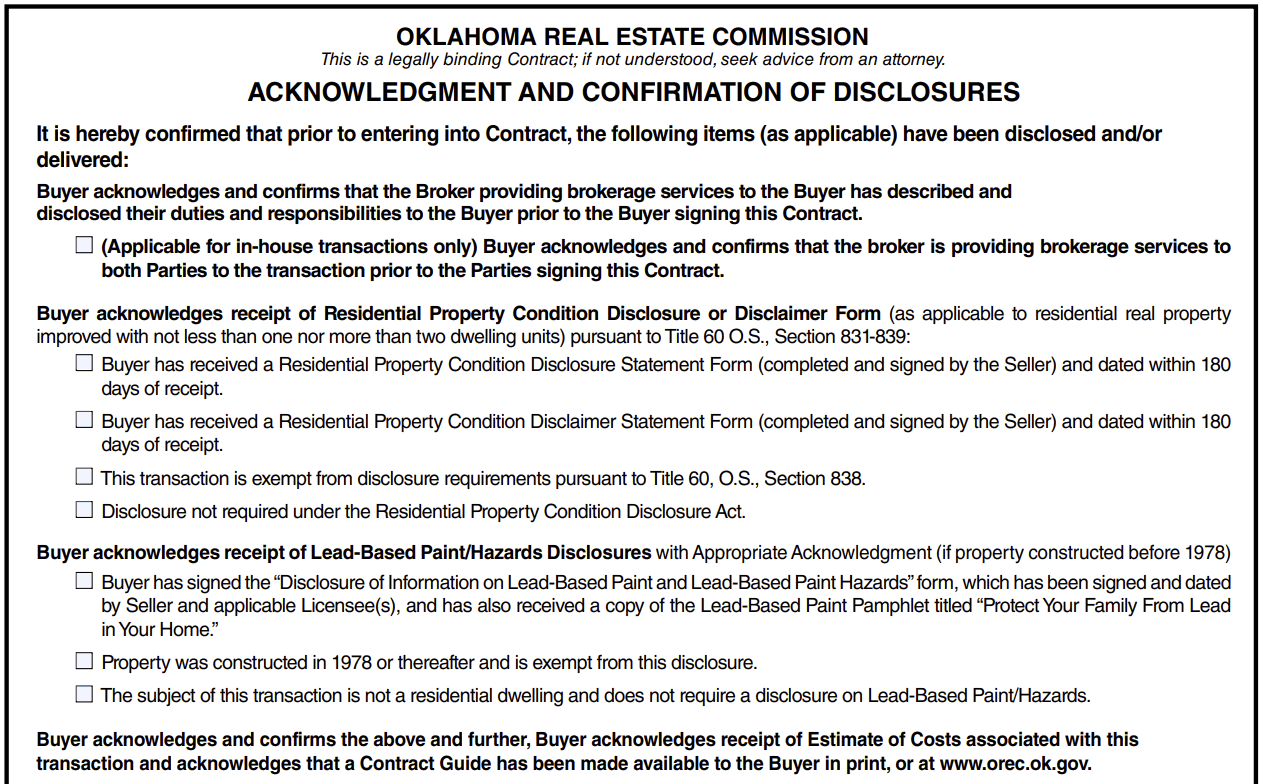
OREC has produced an Acknowledgement and Confirmation of Disclosures which is incorporated into their contracts. This is an excellent way to document the proper delivery of the Disclosure or Disclaimer or a representation that the transaction is exempt.
Psychologically-Impacted Real Estate (59 O.S. § 858-513)
This statute, part of the Oklahoma Real Estate License Code, provides a list of things which are legally not “material defects” requiring the seller to disclose them, but which a buyer might be concerned about. It provides a mechanism for a concerned buyer to make a formal inquiry of the listing agent and for the seller to respond or choose not to respond. This applies to all real estate, not just residential property, but only applies to transactions where a real estate licensee is involved, because it is only contained in the License Code. The only disclosures that are mandatory for sellers are contained in the RPCDA, so the seller’s response is optional.

Conditions causing a property to potentially be psychologically-impacted include, but are not limited to:
- Actual or suspected suicide or homicide on the property (does not apply to any other deaths, but check RPCDA for property condition-related deaths)
- Actual or suspected felonies on the property
- Actual or suspected current or prior occupancy by a person with HIV/AIDS or other disease deemed highly unlikely to be transmitted simply via occupancy of a dwelling
The process:
- A concerned buyer makes a written request for disclosure (the OREC contracts limit this investigation to the inspection period).
- The licensee assisting the seller is required to inform the seller of the request, inform the seller that they may respond or choose not to respond.
- The licensee assisting the seller replies to the buyer with the seller’s response or that the seller declined to respond.
- If using the OREC standard contracts, the buyer should conduct this inquiry during the inspection period and the seller’s response or lack of response could cause the buyer to exercise their termination right.
--------
Bart Stockton is Associate Broker (TX & OK) and Chief of Operations for Paragon. An educator at heart, Bart writes and instructs continuing education courses focusing primarily on the topics of contracts, law, ethics, and risk reduction. He has been using em dashes since well before the robots were taught how to write. Nothing in this post shall constitute legal advice; consult a skilled real estate attorney. ©2025 Bart Stockton Real Estate Education. All rights reserved. Used by permission.