

Do the signatures & dates on a Lead-Based Paint Addendum really matter?
Absolutely, they do!
Absolutely! The Seller's (or Landlord's) disclosure of lead-based paint hazards is required by federal law - and brokers are also required to ensure compliance. Sellers (Landlords) must disclose known hazards or reports to Buyers (Tenants), who must also receive the pamphlet Protect Your Family from Lead in Your Home, prior to being obligated to the contract or lease. The signatures and dates in the proper order confirm the proper (and timely) disclosure activities.
Let’s unpack this…

Understanding Lead-Based Paint and Its Hazards
Simply put – lead-based paint contains lead. Lead is a “heavy metal” once prized for its durability and pigment quality. It was widely used in homes built before 1978, when the federal government banned its residential use under the Consumer Product Safety Commission (CPSC) regulation 16 CFR Part 1303.
When lead-based paint deteriorates, such as through peeling, chipping, sanding, or renovation, it can release toxic lead dust or particles. Lead exposure is especially dangerous for children and pregnant women and can cause developmental delays, neurological damage, and other serious health problems. Even small amounts of lead dust can be harmful.

The Lead-Based Paint disclosure requirements originate in Section 1018 of the Residential Lead-Based Paint Hazard Reduction Act of 1992, enacted as Title X of the Housing and Community Development Act of 1992 and codified at 42 U.S.C. § 4852d. Enforcement of the disclosure provisions was assigned jointly to the U.S. Department of Housing and Urban Development (HUD) and the U.S. Environmental Protection Agency (EPA). In addition, Title X amended the Toxic Substances Control Act of 1976 (15 U.S.C. § 2601 et seq.), granting EPA authority to regulate lead-based paint inspection, abatement, and renovation work practices under that separate statute.
“Target Housing” and Exemptions
The federal lead-based paint disclosure requirements apply to most residential dwellings built before 1978, defined under 42 U.S.C. § 4851b(27) as “target housing.”
Target Housing Defined
“Target housing” means any housing constructed prior to 1978, except housing for the elderly or persons with disabilities (unless a child under six years of age resides or is expected to reside there). In other words, the year 1978 is the dividing line—homes built in or after 1978 are not considered target housing and therefore are not subject to the federal disclosure rule. The term applies regardless of whether the property is single-family or multifamily, and whether it is offered for sale or for lease.
What if the property was built *in* 1978? Enforcement FAQs indicate that the building permit date (or if no permit was obtained, then the date construction started) is used to determine the “constructed date. Therefore, it may be advisable to complete the disclosure requirements for 1978-built properties which did not start construction on or after January 1, 1978.

Common Exemptions
Even among pre-1978 housing, certain properties and/or transactions are exempt from the federal disclosure requirements under 24 CFR § 35.82 and 40 CFR § 745.101:
-
Zero-bedroom dwellings – Units where living and sleeping areas are not separated, such as studio apartments, efficiencies, or dorm rooms, and the rental of individual rooms in residential dwellings.
-
Housing for the elderly or persons with disabilities – Exempt only if no child under age 6 resides or is expected to reside there.
-
Short-term rentals – Leases of 100 days or less, with no renewal or extension expected.
-
Foreclosure sales – Sales conducted by a lender who has acquired the property through foreclosure (but later resale by a purchaser is not exempt).
-
Lease renewals with no new information – If the same tenant renews a lease for the same unit and the original disclosure was already made and remains accurate.
-
Leased property sold to a new owner – disclosure only required if there is a new lease created or the current lease is significantly amended, unless the new owner has actual information or reports that has not been previously disclosed to the tenant.
-
Certified lead-free housing – Units documented by a certified inspector or risk assessor as free of lead-based paint or lead-based paint hazards.
-
Other specialty housing such as a houseboat or recreational vehicle.
-
Commercial or non-residential properties – The rules apply only to residential “target housing.” See below for information on “gray area properties” such as schools or daycares.
Federal Disclosure Requirements
40 CFR Part 745 (EPA) and 24 CFR Part 35 (HUD) govern disclosure obligations for residential properties built before 1978.
Seller/Landlord Duties
-
Disclose known lead-based paint and lead-based paint hazards.
-
Provide all available records or reports related to lead-based paint in the dwelling. This includes any information on abatement or negative test results.
-
Deliver the EPA pamphlet Protect Your Family from Lead in Your Home before the buyer or tenant becomes obligated under a contract or lease.
-
Allow a 10-day period (or another agreed time) for the buyer to conduct a lead-based paint inspection or risk assessment.
Duties of Real Estate Brokers and Agents
Under 24 CFR 35.88 and 40 CFR 745.115, brokers and agents share a statutory obligation to ensure compliance.
-
They must inform the Seller/Landlord of their duty to disclose and to provide the pamphlet.
-
They must ensure that all required activities, signatures, and dates are completed before the parties are bound.
-
They must retain a copy of the completed disclosure for at least three years from the closing of the transaction or lease signing.
Interestingly, the law puts the burden not only on the Listing Broker/Agent to ensure that all obligations have been timely met and documented, but also on the Buyer’s or Tenant’s Broker if they are being compensated by the Seller or Landlord (even if compensation flows through the Listing Broker).

Disclosure Order and Timing of Signatures
-
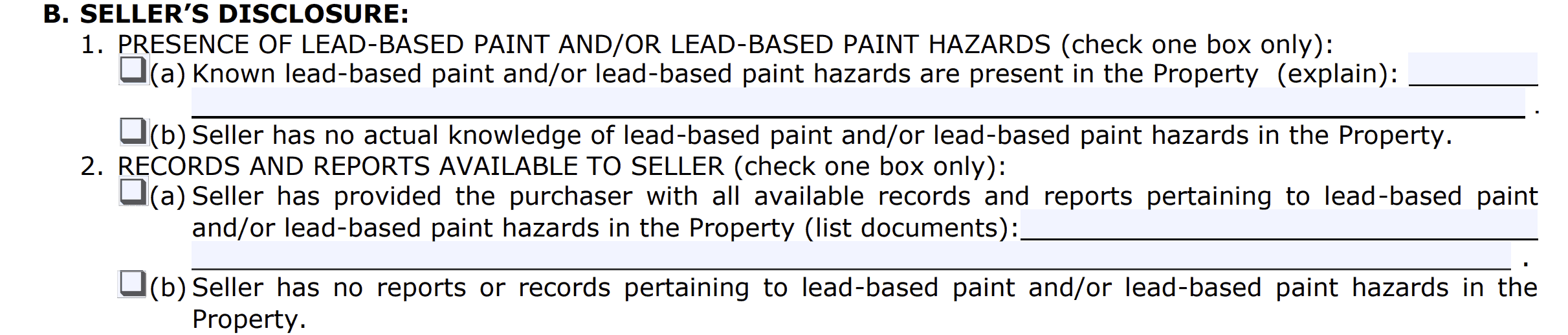
The Seller or Landlord completes their sections regarding their knowledge and any reports available, or the lack thereof.
-
The Seller or Landlord sign and date their signature(s)
-
The Prospective Buyer or Tenant receives the seller-completed disclosure, and any reports.
-
The Prospective Buyer or Tenant receives the EPA pamphlet Protect Your Family From Lead in Your Home.
-
The Prospective Buyer decides if they want to retain or waive their statutory right to an inspection period to test for lead-based paint hazards (not applicable for leases). The parties may agree to a different time period for the inspection, but the Seller cannot force the Buyer to waive their legal right to inspect and terminate if lead-based paint hazards are found.
-
The Prospective Buyer or Tenant signs the form and dates their signature.
-
The agents or brokers sign and date their signatures to confirm that the Seller or Landlord have complied with the law.
As you can see, all signatures and dates on the Lead-Based Paint Addendum or Disclosure must precede the Effective Date of the sales contract (or the lease’s final execution date). This timing is critical because the buyer or tenant’s right to receive information and conduct testing must occur before they are bound to the agreement, according to the law.

Which Form to Use?
The federal government produces a compliant form which may be used, but individual states or entities may produce their own versions of the form if they are essentially the same as the federal form which is based on the statutes.
TEXAS
In Texas sales contracts, we almost always use the TREC form Addendum for Seller’s Disclosure of Information on Lead-Based Paint and Lead-Based Paint Hazards as Required by Federal Law (form number OP-L). Rolls off the tongue, doesn’t it? TREC does not produce leasing forms, so we commonly use the TEXAS REALTORS® Addendum Regarding Lead-Based Paint (TXR 2008) for lease transactions.
OKLAHOMA
For Oklahoma transactions, both of OREC’s forms are titled Disclosure of Information on Lead-Based Paint and/or Lead-Based Paint Hazards, so one must be careful to choose the correct version for the transaction – Lessor & Lessee or Seller & Buyer.
Pro-tip: if you’re doing a lease transaction and the form presented says “Seller” and “Buyer”, then you have the wrong form – in either Texas or Oklahoma.

Federal Enforcement and Penalties
Both HUD and the EPA enforce the federal disclosure laws. Violations can result in:
-
HUD or EPA fines for Sellers, Landlords, Property Managers, and/or Brokers up to $21,018 per violation (as of October 2025; adjusted annually for inflation under 40 CFR §19.4).
-
Criminal prosecution by the Department of Justice/US Attorney’s Office resulting in fines, restitution, and other remedies.
-
Private civil action brought by Buyer or Tenant under 42 U.S.C. § 4852d(b)(3), which could result in treble damages for proven harm as well as attorney’s fees and court costs, and/or rescission of the contract or lease as equitable relief.
-
Potential license discipline for brokers under applicable licensing statutes or rules.
-
In serious cases, enforcement actions have included administrative orders, civil suits, or consent settlements requiring public disclosure of violations, implementation of lead hazard abatement programs, and long-term compliance monitoring.
Case Snapshots: When Brokerages Get Fined
Either HUD or EPA can enter brokerage offices and arrange to pull transaction files to check compliance with the disclosure rules. In some cases, the damage goes beyond fines and into criminal prosecution. Brokers don’t typically make the news headlines for LBP violations unless there are massive problems with their property management practices and records, but even sales and leasing transactions are subject to scrutiny and penalties – sometimes even criminal prosecution.
Coldwell Banker (NRT West, Inc.) – California (EPA Region 9, 2022). EPA found the brokerage, acting as the seller’s agent, failed to ensure that sellers complied with Section 1018 disclosure duties in seven residential transactions from Aug 2017 through Oct 2018—missing pamphlet delivery, lead warning language, and signature dates. Penalty: $35,433 civil fine.
Carrington Real Estate Services – Kern County, CA (EPA Region 9, 2016). Brokerage settled allegations of violating the Lead-Based Paint Disclosure Rule in six home sales between 2010-2012. EPA cited failures to provide the Protect Your Family From Lead in Your Home pamphlet and the required contract language, and to give buyers a 10-day inspection opportunity. Penalty: ≈ $20,000 civil fine + ≈ $60,000 in community-benefit projects (blood-lead analyzers for local clinics).
Valley Property Partners LLC d/b/a “House Dudes” – Moorhead, MN (USAO–ND, 2024). In 2019, the company sold a pre-1978 home without providing the required disclosure form or pamphlet. In 2022, two children aged between 1 and 2 years old were diagnosed with elevated blood lead levels. DOJ prosecuted; the firm pleaded guilty. Penalty: $10,000 fine, $4,275 restitution, 1 year probation, 50 hours of community service, and mandatory LBP notice posting on broker's website.

Tricky Spots (Based on EPA-published guidance)
-
What if the target housing was extensively remodeled or “taken to the studs”? Even if the property seems low-risk—for example, a remodeled home with new drywall and finishes—the exemption applies only if the property has been certified lead-free by a qualified professional.
-
What if property is gifted to someone and neither sold nor leased? Lead-based paint disclosure rules do not apply to gifted property (e.g. there is no sale or exchange of either money or other consideration).
-
What if housing is provided in lieu of monetary compensation? (e.g. clergy residence, employee perk). This housing is not exempt.
-
What about mobile or manufactured homes? Not exempt. Although most components are prefabricated, if they were completed prior to 1978, some of the components could have been repainted with lead-based paint.
-
What about condo associations and cooperatives? Not exempt, but the disclosing party may be either the unit owner or the association/co-op itself, depending on ownership, lease, or shares structure. If disclosure is up to the individual owner, lessor, or shareholder, they are also responsible for any known lead-based paint presence or reports that are in the possession of the association or co-op.
-
Does the disclosure requirement extend to outbuildings, garages, sheds, fences, fixtures, and mechanical equipment? Yes – for most urban and suburban residential lots, the entire property is typically considered to be of residential use. For larger or mixed-use properties, it is a judgement call as to which parts of the property are used primarily for residential purposes. For example, on a ranch property, the house and immediate surroundings (such as the garage) are likely “residential” use, whereas the barns or pens could be seen as devoted primarily to the agricultural endeavor.
-
What if the home was built after 1978 but some antique components have been installed? This situation has not been specifically addressed by the federal government, however, the EPA’s guidance on renovated property, outbuildings, fences, sheds, and equipment could reasonably be applied to other pre-1978 components which have been made part of the property. The best course of action would be to complete the LBP disclosure requirements but also disclose which components are
-
What if the Seller/Landlord’s knowledge and reports are based on a home test kit? Even though official sources (such as the EPA pamphlet) cast doubt on the reliability of home test kits, results of home test kits must be disclosed, along with information about the reliability of the test kit results.
-
If the Seller has exemption to other mandatory disclosures, such as the Seller’s Disclosure Notice (TX) or Residential Property Condition Disclosure (OK), are they exempt from the federal lead-based paint disclosure rules? No. Exemption from various state-level required disclosures does not affect the Seller or Landlord’s requirements under federal lead-based paint disclosure rules.
Schools, Daycares, and Other “Gray Area” Properties
When lead-based paint rules apply outside typical housing
The federal Lead-Based Paint Disclosure Rule under Title X, Section 1018 (40 CFR 745 & 24 CFR 35) applies only to residential “target housing” built before 1978. That means most commercial, institutional, or public buildings—such as schools, daycare centers, offices, and churches—are not covered by the disclosure requirements that apply in a home sale or lease.
However, that does not mean these buildings are unregulated. Several related federal and state laws govern how lead hazards are managed in non-residential or child-occupied settings.
Federal “Child-Occupied Facility” Rule
Under the EPA’s Renovation, Repair, and Painting (RRP) Rule (40 CFR 745, Subpart E), any pre-1978 building that meets the definition of a child-occupied facility must follow lead-safe work practices whenever renovation, repair, or painting work disturbs painted surfaces.
A child-occupied facility includes schools, daycares, preschools, and similar sites where the same child (age 6 or younger) visits:
- On at least two separate days per week,
- For 3 hours or more each day, and
- 60 hours or more per year.
Contractors working in such facilities must be EPA-certified (or state-certified in states authorized to administer their own RRP program) and must follow containment, cleanup, and record-keeping protocols. Although this rule is about safety and work practices, not buyer/tenant disclosure, owners and brokers should be aware that renovation triggers different obligations than sale or lease.
Hybrid or “Mixed-Use” Properties
Some properties combine both residential and nonresidential uses—for example:
-
Churches or schools with attached parsonages or staff housing,
-
Home-based daycare facilities, or
-
Boarding schools or residential treatment centers with on-site living quarters.
In those cases:
-
The residential portions are subject to the Title X disclosure requirements if built before 1978 and offered for sale or lease.
-
The child-occupied or public portions are subject to the EPA’s RRP Rule during renovation or maintenance activities.
#adviceforagents #technicallyspeaking #disclosures #contractadvice #leadbasedpaint #inspections #texasrealestate #oklahomarealestate
-----
Bart Stockton is Associate Broker (TX & OK) and Chief of Operations for Paragon. An educator at heart, Bart writes and instructs continuing education courses focusing primarily on the topics of contracts, law, ethics, and risk reduction. Nothing in this post shall constitute legal advice; consult a skilled real estate attorney. ©2025 Bart Stockton Real Estate Education. All rights reserved. Used by permission.