

The Termination Option in Texas Real Estate Contracts
The contract forms promulgated by the Texas Real Estate Commission (TREC) have a somewhat peculiar provision called the Option Period. You may have heard the term “option contract” before, but options in real estate contracts are typically concerned with the option to purchase rather than the option to terminate.

The Texas contracts’ Termination Option is the Buyer’s unilateral and unrestricted right to terminate the contract for any reason (or no reason) within a certain amount of time after going under contract. Contrast this to many states’ contract forms which provide for an inspection and negotiation period which only allows the Buyer to terminate if inspections are unsatisfactory or the parties fail to reach agreement on repairs or credits in lieu of the Seller making repairs to the property.
Purpose of the Option Period
The TREC contracts allow the Buyer to inspect that property at reasonable times, and this is totally separate from the Option provisions. However, the Buyer has the most leverage to inspect the property and negotiate repairs or credits during the Option Period, when they can terminate without penalty and receive a refund of their Earnest Money. For this reason, most inspections and negotiations relative to property condition occur during the Option Period.
Requirements for Having a Valid Option Period
-
The contract’s Paragraph 5 must be completed properly to specify both an Option Fee amount in dollars (Para. 5A) and the number of calendar days for the Option Period (Para. 5B).
-
The Buyer must timely deliver the Option Fee to the Escrow Agent (Title Company).
-
If the Buyer desires to terminate under their Option Period, they must do so in writing no later than 5:00pm local time on the final day of the Option Period.
Money Required
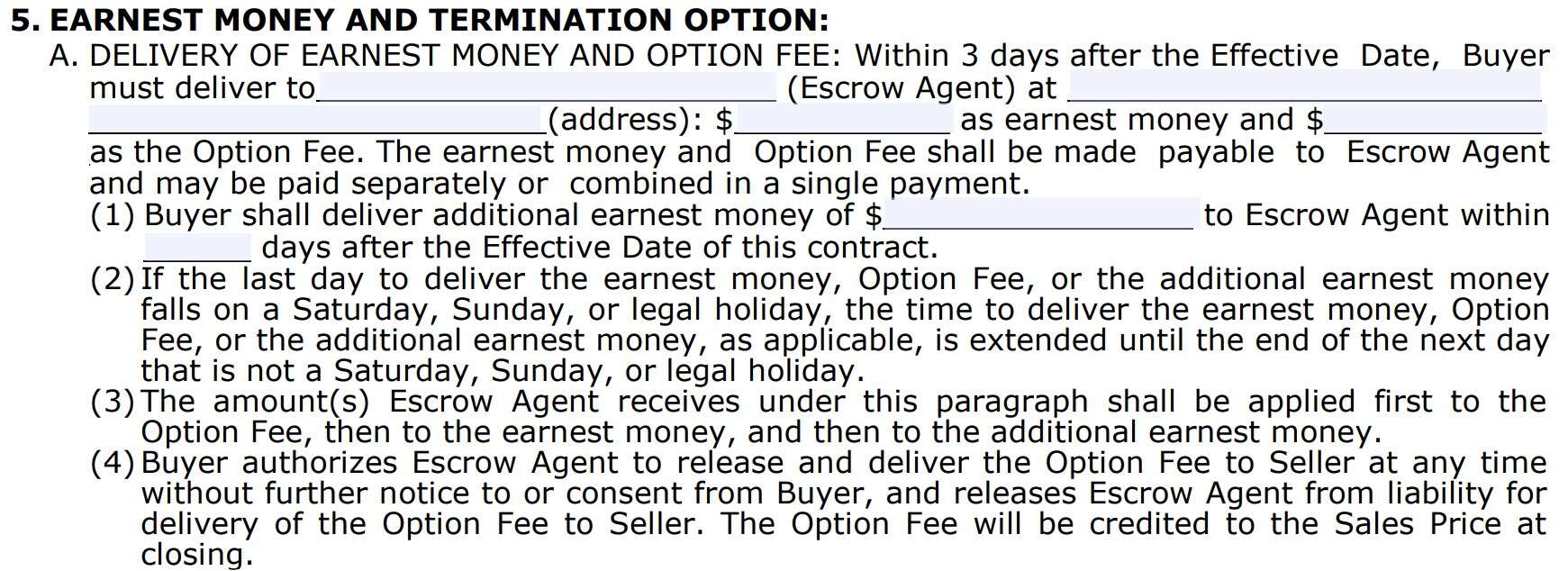
The Termination Option in the Texas contracts exists as a “contract within a contract” and every contract needs consideration to be valid. This means that the Buyer will need to pay the Option Fee to the Escrow Agent or Title Company conducting the escrow. The amount is based on the agreement of the Buyer and Seller and could be a nominal amount (like $100) or several thousand dollars, based on the perceived cost of removing the property from the market for that period of time.
Timeline for Delivery
The Buyer must deposit the Option Fee with the Escrow Agent no later than the third (3rd) calendar day after the contract’s Effective Date. If that third day falls on a Saturday, Sunday, or legal holiday, the deadline is extended to the next day that is not a Saturday, Sunday, or legal holiday. “Legal holiday” is not currently defined in the contract but expect that definition to come in a future edition.
The case law and contract indicate that the promise to pay the Option Fee is enough consideration until it is actually paid – however the contract says that the Option is invalid if the fee is not paid before the deadline. Time is of the essence for delivery of the Option Fee.

What if the Buyer Changes Their Mind on an Option Period?
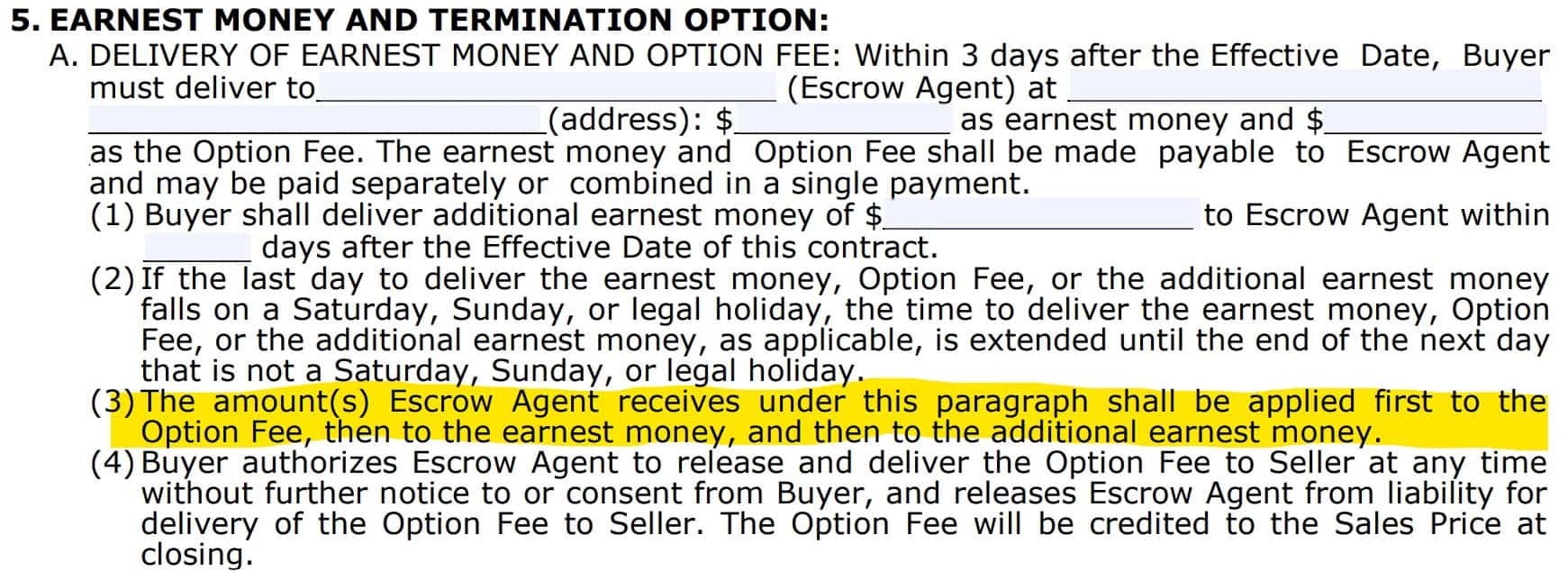
If the contract was executed with an Option Fee and Option Period, the Escrow Agent is required to apply any funds received from the Buyer first to the Option Fee and the remainder toward the Earnest Money. If the parties agreed to an Option Fee and, after execution, the Buyer decides they don’t want the Option Period and therefore does not pay the Option Fee, this does not override the contract’s provisions.
For example, if an investor Buyer decides they don’t want an Option after execution and pays only the $2000 Earnest Money but not the $200 Option Fee, the Escrow Agent must apply $200 for Option Fee and the remaining $1800 toward the Earnest Money. Now, the Earnest Money is short by $200. When the Earnest Money is short after the deadline to deliver, the Seller is granted a right to terminate the contract. Now, the Buyer must rush an additional $200 to the Escrow Agent before the Seller sends a termination notice. In this scenario, the parties could have removed the Option Fee/Period before execution or, if after execution, used an Amendment to remove it and avoid potentially giving the Seller a right to terminate.
Duration of the Option Period
Based on the Buyer’s promise to pay the Option Fee, the Option Period begins at the execution of the contract (the Effective Date), even if the Option Fee has not yet been paid. The Option Period will then expire at 5:00pm local time to the property on the final day of the Option Period. All days in the TREC contracts are calendar days, not business days, and it does not matter if the last day falls on a weekend or holiday. We will cover extensions of the Option Period in a later post.

Exercising the Right to Terminate
The Buyer must given written notice to the Seller if the Buyer chooses to exercise their Termination Option. This should be done on the TREC Notice of Buyer’s Termination of Contract. Because time is of the essence for the Option Period, strict adherence to the deadline is required. A notice given too late would not be effective.
The Option Period Under Various Contingencies
For the Back-Up Buyer under the TREC Addendum for Back-Up Contract, the Option Period will begin at the Effective Date and continue the entire time the Buyer is in the back-up position, without counting the days. Then, if the primary contract terminates and the Back-Up Buyer moves into primary position, the Option Period days will start counting. The 2024 revision to the Addendum for Back-Up Contract allows for a smaller Option Fee to be payable upon execution and an additional amount to be paid when/if the Back-Up Buyer becomes primary at the termination of the first contract. The counting of the Option Period is the same under the TREC Short Sale Addendum.

No Refund of the Option Fee
It is important to note that the Option Fee is never refunded to the Buyer – it can only be credited toward the Sales Price at the closing. If no closing occurs, the Option Fee is forfeited – even under a Back-Up or Short Sale contingency.
-----
Bart Stockton is Associate Broker (TX & OK) and Chief of Operations for Paragon. An educator at heart, Bart writes and instructs continuing education courses focusing primarily on the topics of contracts, law, ethics, and risk reduction. He has been using em dashes since well before the robots were taught how to write. Nothing in this post shall constitute legal advice; consult a skilled real estate attorney. ©2025 Bart Stockton Real Estate Education. All rights reserved. Used by permission.